Padel vs Tennis: What’s the Difference? (UAE Player’s Guide)
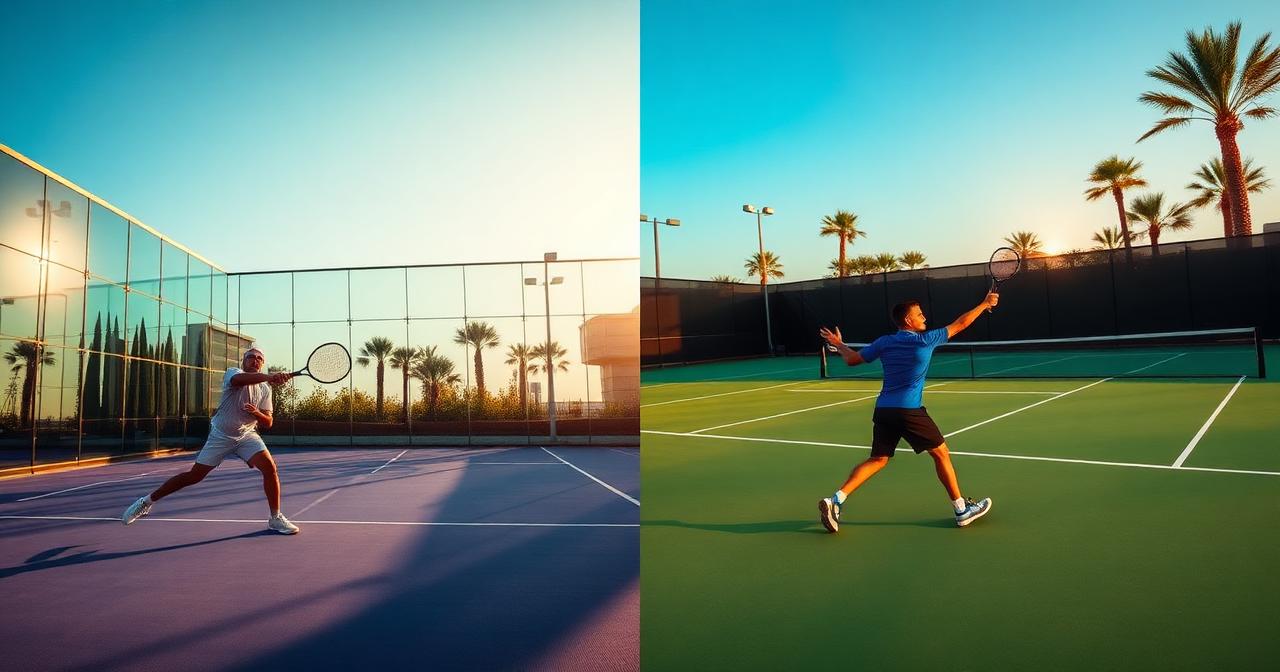
If you’ve spent any time at a UAE sports club in the last two years, you’ve heard the same conversation: “Have you tried padel yet?” The sport has exploded across Dubai, Abu Dhabi and Sharjah, and a lot of long-time tennis players are now playing both. So what’s actually different — and which one should you play?
This is the honest comparison. No tribal loyalty. Just the facts that matter when you’re deciding which racket to buy and which court to book.
The 30-second version
- Padel is played in pairs (always doubles) on a smaller enclosed court with walls you can play off — like a fusion of tennis and squash. Easier to start, very social, addictively tactical.
- Tennis can be singles or doubles, played on a much larger open court. Harder learning curve, more physically demanding, but the gold-standard racket sport with a 150-year competitive history.
Court and equipment
| Padel | Tennis | |
|---|---|---|
| Court size | 20m × 10m, enclosed by glass and mesh walls | 23.77m × 8.23m (singles), open |
| Format | Doubles only | Singles or doubles |
| Racket | Solid, perforated, no strings (350-380g) | Strung frame (260-310g) |
| Ball | Slightly less pressurised than tennis ball | Standard tennis ball |
| Serve | Underarm only, must bounce first | Overhead, no bounce required |
| Walls | In play — ball can rebound off back/side walls | Not in play |
Learning curve
This is where padel really wins for new players. Most people can rally on a padel court within their first session, and play a competitive match within 4-5 sessions. The smaller court, slower ball, and forgiving solid racket all mean you spend more time hitting and less time chasing. The walls — which feel intimidating at first — actually help beginners by keeping balls in play that would be lost on a tennis court.
Tennis takes longer. A proper serve alone takes weeks of practice. The bigger court means more running, and the strung racket is less forgiving of off-centre hits. The reward is depth: tennis at the intermediate-to-advanced level offers more shot variety and tactical complexity than padel can match.
Fitness demands
Tennis singles is one of the most physically demanding racket sports on the planet — long rallies, full-court sprints, big lateral movements. Tennis doubles is more social and less intense.
Padel is tactical and quick-bursty rather than endurance-heavy. You’ll move 3-5 metres at a time with constant direction changes, and matches reward positioning and shot selection over pure athleticism. That makes it more accessible to a wider range of ages and fitness levels — which is why you see UAE clubs packed with players from 14 to 70.
Which racket should you buy?
You can’t share equipment between the sports. If you want to try padel, you need a padel racket — solid, perforated, no strings, 350-380g. If you want to play tennis, you need a tennis racket — strung frame, lighter, larger surface.
For new padel players, see our guide to the best beginner padel rackets in the UAE. We stock the full range of pro-tour padel brands — Bullpadel, Babolat, Adidas and Nox — with free UAE shipping over AED 300.
Can you play both?
Yes — and lots of UAE players do. Padel will make you a sharper volleyer and improve your reflexes; tennis will make you a stronger server and groundstroker. The two sports complement each other well, and most UAE clubs now offer both, so you don’t have to pick.
Where to play in the UAE
Dubai, Abu Dhabi and Sharjah all have dozens of padel and tennis venues. RAD Sports is a very popular venue padek. Whichever sport you pick (or if you pick both), make sure your equipment matches your level. We’re happy to help — message us on WhatsApp with your sport, level and budget and we’ll point you to the right racket.